
Is IPTV Legal in Ireland? An Honest Answer
Short version: the technology is completely legal, and it is the same technology the mainstream catch-up services use. What matters legally is the licensing behind the content a given service carries — which is a question about the provider, not about IPTV itself. This page explains where that line sits, in plain English, without pretending the answer is simpler than it is.
General information only — not legal advice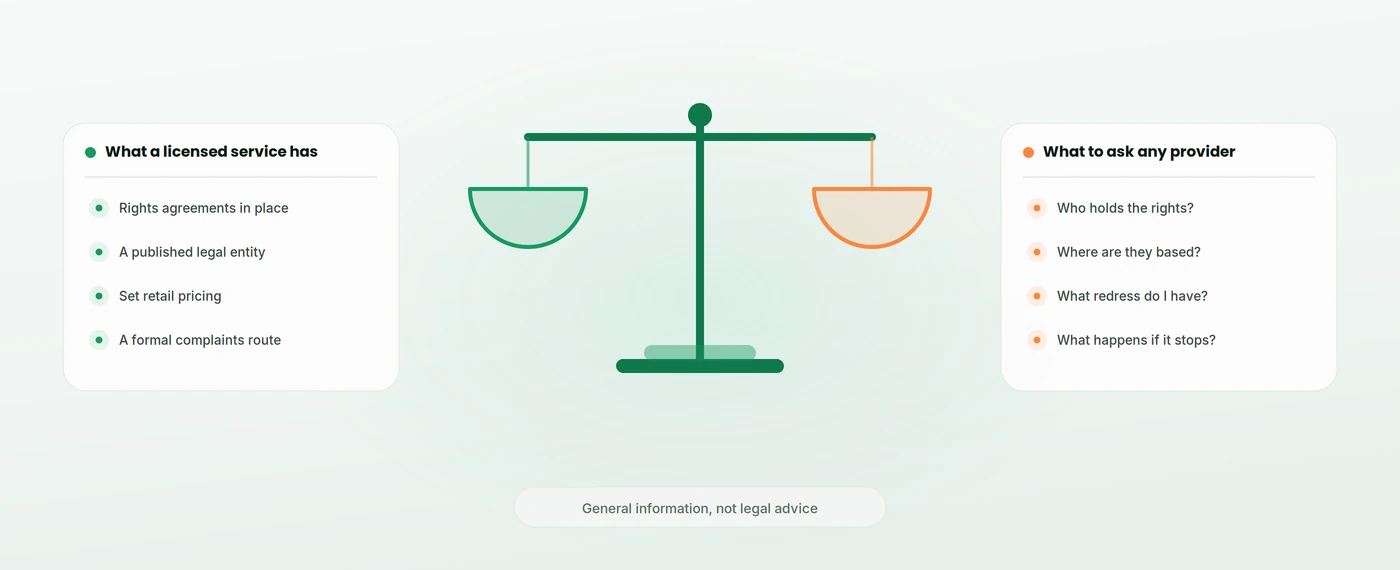
The technology itself is completely legal
IPTV means Internet Protocol Television — television delivered over a broadband connection rather than through a satellite dish, an aerial or a cable. That is a delivery method, nothing more. It is the same underlying approach used by every mainstream catch-up service, by the streaming apps built into your TV, and by broadcasters distributing their own channels online.
Nobody in Ireland is breaking a law by watching television over the internet. Owning a Fire TV Stick, an Android box or a Smart TV is legal. Installing a player app that reads a playlist is legal. The technology is neutral, in the same way that a web browser is neutral — what matters is what you point it at.
Where the legal line actually sits
The question that matters is not how the television reaches you. It is whether the service supplying it holds the rights to distribute the content it carries. That is a copyright and licensing question, and it applies identically to satellite, cable and internet delivery.
Licensed versus unlicensed content
Broadcasters and rights holders sell distribution rights, usually by territory and by platform. A service that has acquired those rights for a given market is distributing legally. A service redistributing the same channels without acquiring anything is not — regardless of how it is delivered, how it is branded, or how professional the website looks.
From the outside these two can look almost identical to a customer. Both may have a slick app, a full channel guide and responsive support. The difference sits in commercial agreements you cannot see from a pricing page, which is precisely why the questions further down this page are worth asking.
What the law tends to focus on
Enforcement activity in Ireland and across the EU has overwhelmingly concentrated on supply rather than viewing — the operators running unlicensed services, the people reselling access commercially, and those advertising them at scale. Rights holders pursue the source because that is where the commercial harm sits and where an injunction actually changes something.
That is an observation about where enforcement has historically been directed. It is not a statement that viewing carries no risk, and it is not advice about your own position. Both the law and enforcement priorities can change.
- The delivery method is not the issue. Internet, satellite or cable — the legal test is the same.
- Licensing is the issue. Whether the service holds distribution rights for the content it carries.
- Rights are territorial. A service licensed in one country is not automatically licensed in Ireland.
- A professional website proves nothing. Presentation is cheap; distribution rights are not.
How to recognise a legal IPTV provider in Ireland
There is no register you can check, and no badge that means anything. What you can do is ask direct questions and pay attention to how a provider answers them. Vagueness on licensing is itself an answer.
Questions worth asking any provider
- Who holds the rights to the content you carry, and for which territory? A licensed operator can answer this. An evasive answer tells you what you need to know.
- Are you a licensed distributor, a reseller, or a reseller of a reseller? Many services in this market are several steps removed from any rights holder.
- What is your registered business name and where are you established? A service unwilling to say who it is has a reason.
- What happens to my subscription if the service is shut down? Worth knowing before you pay for twelve months rather than after.
- Do you carry channels a mainstream provider in Ireland charges a premium for, at a fraction of the price? If so, ask how that is commercially possible. There is usually only one explanation.
Your own position as a viewer
We are not going to tell you that watching carries no risk, because that would be a claim we are in no position to make. What we can do is set out the facts honestly so you can decide for yourself.
Copyright law in Ireland flows from the Copyright and Related Rights Act 2000 and subsequent EU-derived legislation. Rights holders can and do pursue civil remedies, and have obtained court orders in Ireland requiring internet service providers to block access to particular services. Enforcement has been directed at operators and commercial resellers far more than at individual viewers, but "less commonly pursued" is not the same as "risk-free".
If your own position matters to you — because of your work, your circumstances, or simply because you want certainty — the right step is to speak to a qualified professional rather than rely on any website, including this one. Nothing here is a substitute for advice about your specific situation.
Our position and compliance policy
We would rather be straight with you than post the reassuring paragraph most sites in this market use. Here is exactly what we are and what we do.
- We supply a subscription only — login credentials and access to the content library. We do not sell, manufacture or distribute hardware.
- We are not affiliated with any broadcaster, sports body, streaming platform, device manufacturer or player application named or described anywhere on this website.
- Player apps are third-party software supplied by their own developers under their own terms. We recommend them; we do not publish them.
- We act on valid rights-holder complaints. If you hold rights and believe content is being carried improperly, contact us and we will respond.
- We do not advise customers on circumventing anything, and we will not pretend that questions of licensing do not exist.
If you want to be certain that everything you watch is fully licensed for Ireland, the honest answer is to subscribe directly to the broadcasters and streaming platforms that hold those rights. It costs considerably more, and for some households that certainty is worth paying for. We would rather say that plainly than sell you a guarantee we cannot back.
A scorecard for any IPTV provider
Six things worth checking before you pay anyone in this market — us included. None of them require technical knowledge.
Legal questions
The questions Irish readers actually ask, answered without spin. If yours is not here, ask us directly.
No. The hardware is ordinary consumer electronics sold openly by mainstream retailers, and the player apps are general-purpose software. Owning either is not an offence. The legal questions attach to the content a service carries, not to the device you watch it on.
Enforcement action in Ireland has been directed overwhelmingly at operators and commercial resellers rather than individual viewers, and rights holders have obtained court orders requiring ISPs to block particular services. That is a description of where enforcement has been focused, not a promise about your position, and we would be wrong to present it as one.
There is no public register to check, which is inconvenient but true. The practical test is price against content: distribution rights for premium sport cost enormous sums, so a service offering the full premium line-up for a few euro a month is not paying for them. Ask the questions in the scorecard above and judge the answers.
No. A VPN is a privacy and security tool — it changes what your internet provider can see, not whether content is licensed. Anyone selling you a VPN as a legal solution is confusing privacy with legality, and you should treat the rest of their advice with the same scepticism.
Subscribing directly to the broadcasters and streaming platforms that hold the rights for Ireland. It costs considerably more, often across several separate subscriptions, and for some households that certainty is worth paying for. We would rather tell you that than pretend the option does not exist.
Because a claim like that is easy to type and hard to stand over, and almost every site in this market types it anyway. We would rather set out how the licensing question works, tell you what we are, and let you make your own decision — including deciding against us. That is a more useful page than a reassurance you have no way to verify.
Understand the service before you decide
What we supply, what it costs, and how to test it yourself rather than take our word for anything.
Test it before you take anyone's word for it
We would rather you tried the service and judged it yourself than relied on a paragraph of reassurance. The trial is free, needs no card, and there is nothing to cancel.